(801) 601-1298

Call Today

Open 24 Hours

For Emergency Services

Water Softener vs. Water Filtration: Which Is Right for Your Utah Home?

If you’ve lived in the Salt Lake Valley for more than a few months, you’ve probably seen the “white crust” on your showerhead or noticed your tap water has a slight “swimming pool” scent. It’s just part of the local charm. Well, not exactly.

Most people know their water needs something, but they get stuck deciding between a water softener and a filtration system. At Plumbing Utah, we see homeowners buy a filter thinking it will save their dishwasher from limescale, or install a softener hoping to get rid of a metallic taste.

The reality? They are two different solutions, each with their own set of benefits.  This article is intended to help you understand the difference and what a whole home filtration system, versus a water softener can do you for.  By the end you should have a better understanding of which utility is better for you situaiton and why. 

The Problem vs. The Solution

The reason we compare these two is simple: Utah water is a double-threat.

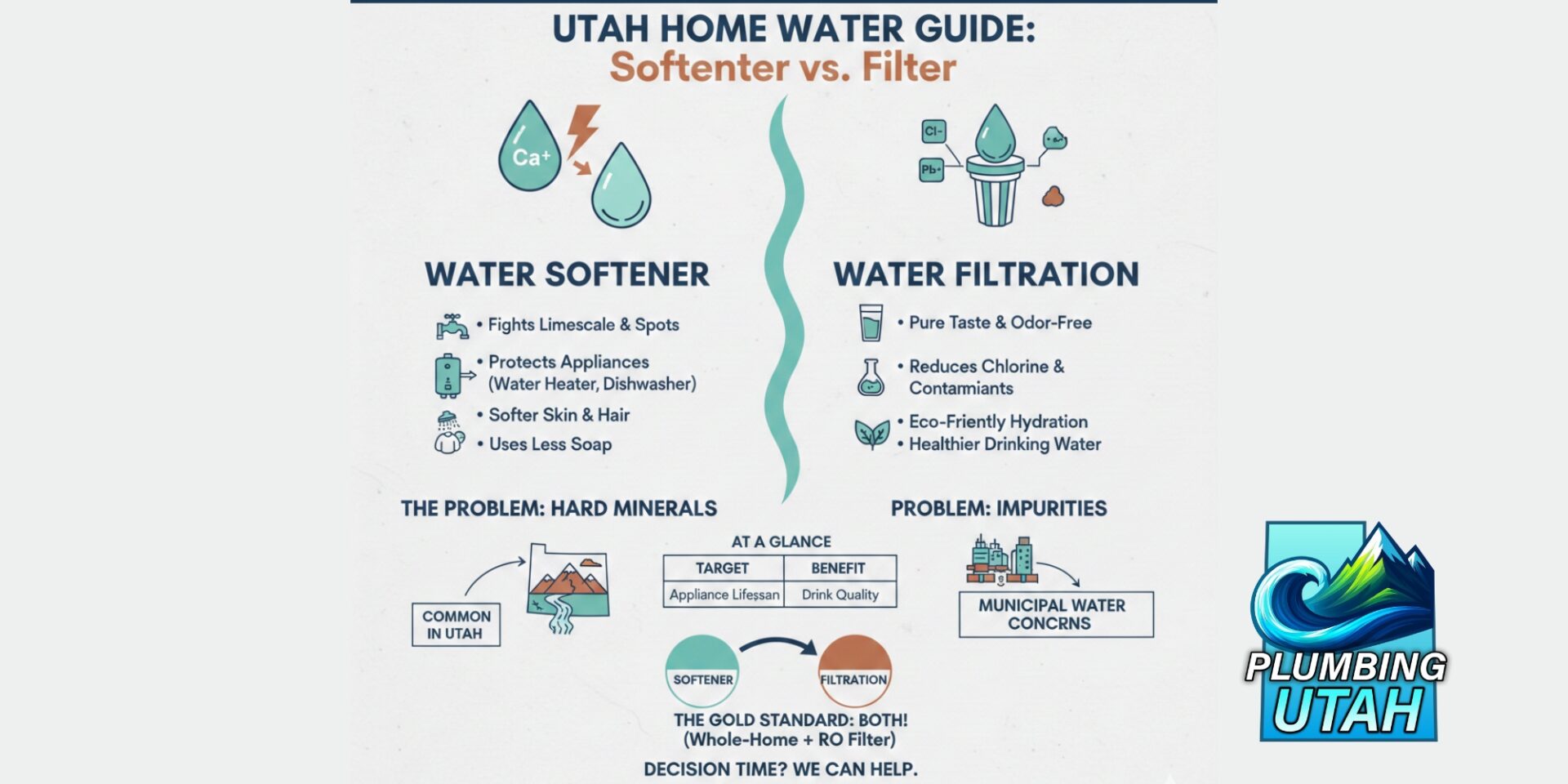
Our water is naturally “hard” (high in minerals), which is an infrastructure issue. But it’s also treated with chemicals like chlorine, which pose quality and health problems. A softener adjusts how the water behaves in your pipes; a filter adjusts how the water tastes and feels in your glass.

1. The Water Softener: Protecting Your Investment

In Utah, our water is packed with calcium and magnesium. It’s basically liquid rock. A water softener’s only job is to swap those minerals for tiny amounts of salt (ion exchange).

What a Softener is primarily for:

  • Saving your appliances: Hard water acts like sandpaper inside your water heater and dishwasher. A softener can literally double the life of these expensive machines.
  • Ending the “Limescale Battle”: You know that white film on your glassware and the crusty buildup on your faucets? A softener stops that at the source.
  • Skin and Hair Health: If you’re constantly moisturizing because your skin feels itchy or your hair feels “crunchy” after a shower, it’s likely due to mineral buildup. Soft water rinses soap away completely.

2. Water Filtration: Focusing on Purity

While a softener handles the “rocks,” a filtration system handles the ” chemicals.”” Even if your water is soft, it might still contain chlorine, lead, or sediment you don’t want to drink or cook with.

What Filtration is primarily for:

  • Flavor and Odor: If your morning coffee tastes a bit “off” or your water smells like a municipal treatment plant, carbon filtration strips out those odors.
  • Contaminant Safety: Filters (especially Reverse Osmosis systems) can target specific worries like lead, PFAS (“forever chemicals”), and pesticides.
  • The Bottle-Free Life: If you’re currently lugging heavy cases of bottled water from the grocery store, a high-quality filter pays for itself in a few months.filter

If you see/feel…

You likely need a…

Because…

White spots on dishes

Water softener

It’s caused by mineral deposits

A “bleach” or pool smell

Water filtration

It’s caused by chlorine treatment

Itchy, dry skin

Water softener

Minerals prevent soap from rinsing off.

Metallic or bitter taste

Water filtration

It’s caused by contaminants or old pipes.


The Verdict: How Do You Choose?

The “right” choice isn’t a toss-up; it’s based on your priorities.

If you just moved into a brand-new home and want to keep your plumbing pristine for twenty years, start with a softener. If you’re more worried about what your kids are drinking and want the best-tasting ice cubes in the neighborhood, start with a filtration system.

Honestly? In many parts of Utah, the “gold standard” is a hybrid approach. Using a softener to protect your home’s pipes while using a Reverse Osmosis (RO) system under the kitchen sink for drinking water is the most popular setup for a reason—it solves both sides of the Utah water equation.

Still not sure what’s flowing through your pipes? Don’t guess. We can run a quick water test to tell you exactly how many “grains” of hardness you have and what your chlorine levels look like.

Give Plumbing Utah a call (801) 601-1298 and let’s figure out a system that actually makes sense for your house.

Archives